Paul Pritchard challenges St Brendan-Shaw College students to rethink adventure
Who gets to have an adventure?
Adventurer, author and disability advocate Paul Pritchard challenged students at St Brendan-Shaw College to consider that question during a powerful presentation exploring resilience, disability, empathy, risk and the life-changing experiences that shape who we become.
Speaking with Senior Secondary Outdoor Education classes and male The Rite Journey students, Paul shared stories from a life that has taken him climbing across Patagonia, Baffin Island and the Himalayas of Pakistan and Nepal, through a catastrophic accident in Tasmania, and ultimately back into the mountains and wild places he loves.
“We each have a story, and they’re all equally as important,” Paul told students.
His presentation unfolded against a backdrop of striking images from decades of expeditions. As a professional climber, Paul described seeking challenge, solitude and what he called “truth in vertical spaces”.
But on Friday 13 February 1998, his understanding of adventure changed forever.
A life-changing climb on Tasmania’s Totem Pole
Paul and his climbing partner Celia Bull had travelled to the Totem Pole at Cape Hauy, near Fortescue Bay on Tasmania’s Tasman Peninsula, to climb the extraordinary slender sea stack rising directly from the Southern Ocean.
During the climb, a falling rock struck Paul from approximately 25 metres above, causing a devastating traumatic brain injury.
Celia carried out an extraordinary rescue effort, hauling Paul to a ledge before climbing out and running kilometres for help. Paul was eventually rescued after spending hours critically injured on the Totem Pole.
The accident left him with significant and permanent disability and required an extensive period of rehabilitation.
What followed changed Paul’s understanding not only of climbing, but of challenge itself.
“I had to transition from a life where I sought challenge to one where the challenge was, and still is, to live to a certain extent,” he said.
Small achievements during rehabilitation began to take on the significance that summits once had. Walking a few additional steps became progress. Eventually, those steps led back outdoors, then to hills and mountains.
Seven years after his injury, Paul reached the summit of Mount Kilimanjaro as part of a pan-disability climbing expedition.
Who gets to experience adventure?
This question became central to Paul’s conversation with students.
His experiences of disability, including prejudice and discrimination, prompted him to examine the assumptions society makes about what people can and cannot do.
“We humans are very good at making cages for ourselves,” he said, describing cages created not with bars, but through “labels and assumptions and stories about what we can and can’t do”.
Paul spoke about the people who supported him after his injury and the profound difference made by those who saw possibility rather than limitation.
“I seldom heard, ‘You can’t do that’,” he told students.
“More often I heard, ‘What do you want to experience, and how can we make this happen?’”
For Paul, this is also at the heart of inclusion. Providing meaningful support does not mean removing every challenge or risk. It means enabling people to participate, make choices and pursue experiences that give life meaning.
The dignity of risk
Paul introduced students to the concept of the dignity of risk, particularly in relation to people with disability.
Adventure, he argued, should not belong only to people who fit a traditional image of being young, fit and able-bodied.
“Nature doesn’t care about your diagnosis, your background, your past,” he said. “It simply invites you in.”
His message extended well beyond disability.
All people experience challenges, uncertainty and fear. The response is not necessarily to eliminate those experiences, but to develop the support, courage and adaptability needed to move through them.
Asked by students about fear, Paul encouraged them not to wait until fear disappears before taking action.
“Whatever you’re scared of … lean into it,” he said.
Returning to the Totem Pole
Almost two decades after the accident, Paul returned to the Totem Pole.
He described the place to students as one of “reckoning and renewal”.
This time, climbing looked very different. A team of friends and experienced supporters helped make his return possible.
In 2016, 18 years after his accident, Paul reached the top of the Totem Pole.
For Paul, the achievement demonstrated something more important than simply reaching a summit.
“Without a team of friends and that rope, it would have been impossible for me to realise a long-held dream,” he said.
“With the right support, all people, not just disabled people, are capable of so much more than anything.”
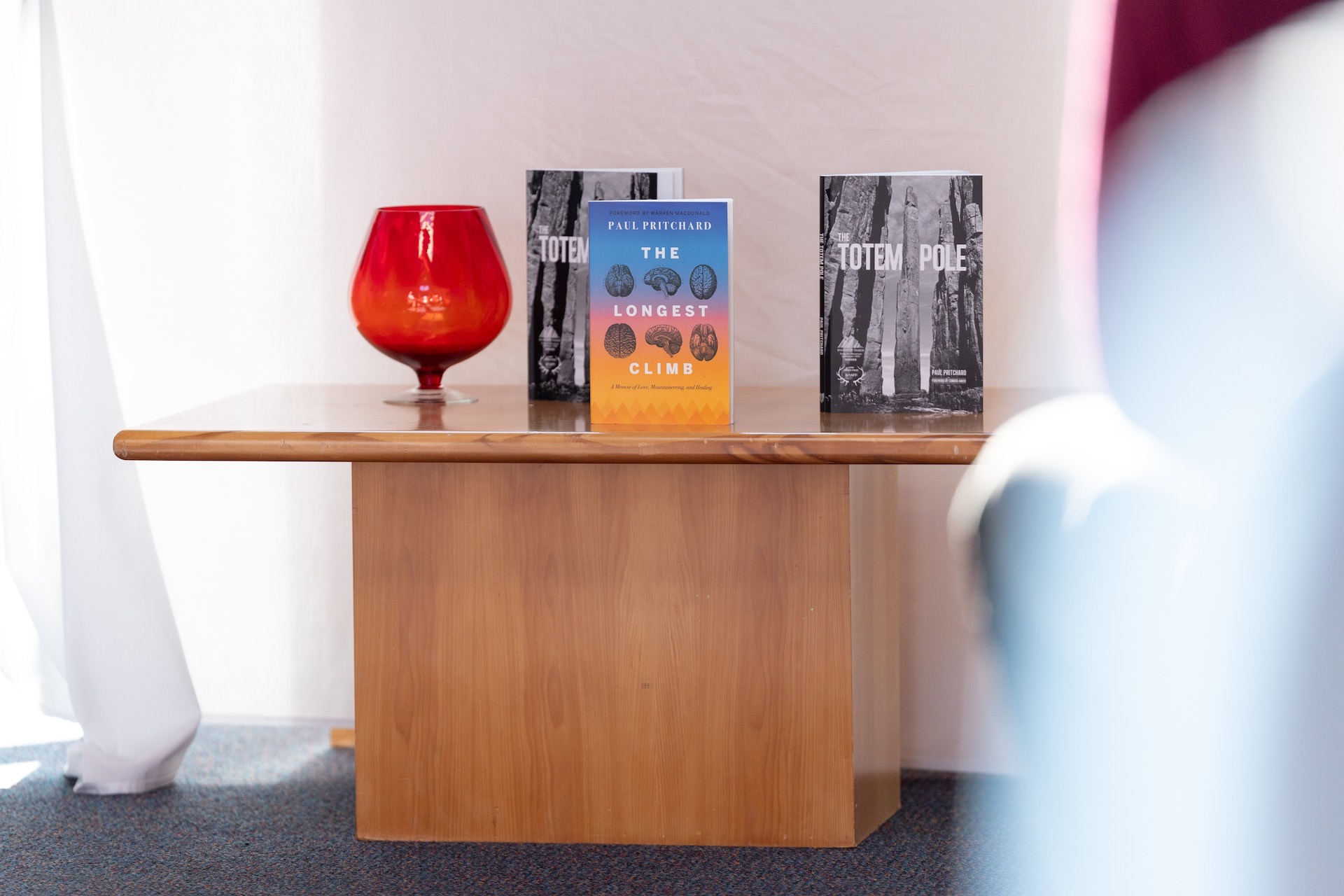
Paul has written extensively about climbing, adventure and disability. His books include Deep Play, The Totem Pole and The Longest Climb.
Larapinta: End to End
Students were also introduced to Paul’s more recent adventure through the documentary Larapinta: End to End.
The 2025 film follows four adventurers with disability as they undertake an expedition through some of Australia’s harshest terrain, challenging assumptions about disability and what people are capable of achieving. It is currently available to stream free on SBS On Demand.
Paul described the project as another opportunity to normalise disability rather than portray people with disability as either victims or “superhuman”.
It was a fitting extension of a presentation that asked students to think about the value of adventure, our connection with nature and one another, and how we respond when the life we expected changes course.
For students in The Rite Journey, the conversation also provided a powerful context for considering life-changing events, adversity and the people we become through the challenges we encounter.
Paul’s definition of adventure is no longer simply about climbing the world’s most difficult mountains.
“It’s not about reaching a summit,” he said.
“It’s about finding another way to keep climbing.”
Type on the line above then press the Enter/Return key to submit a new search query